
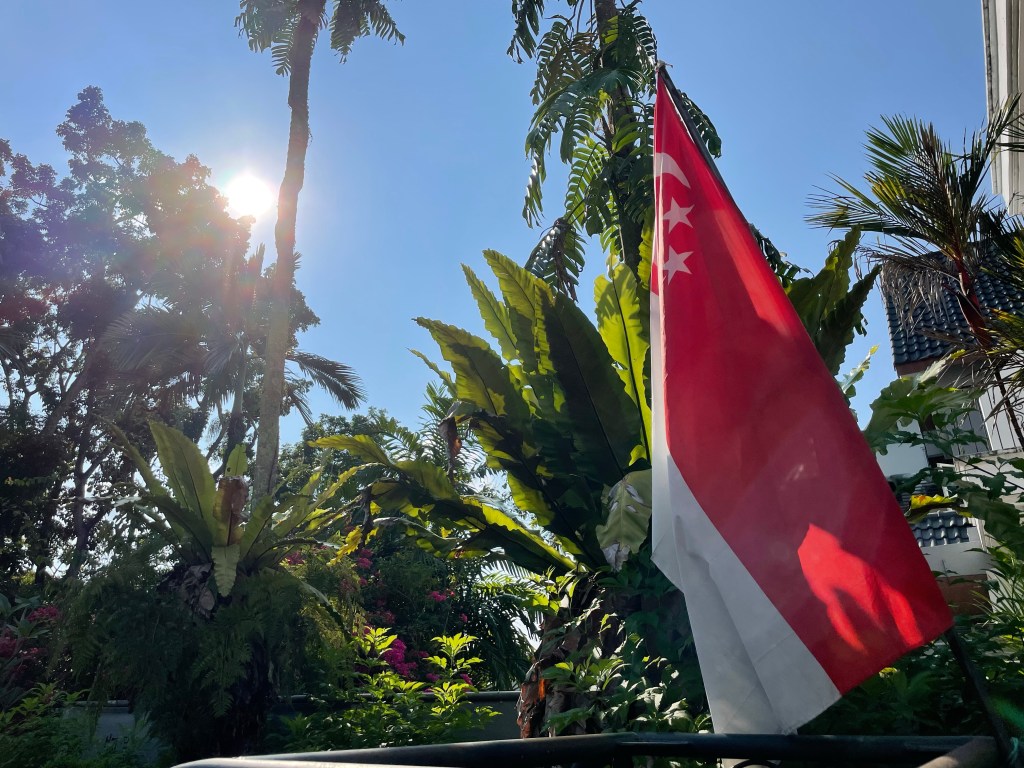
When we celebrate Singapore’s National Day, what are we celebrating?
Dear friends,
As I woke up today and prepared for the day, I found a strange sense of uneasiness welling up in me. This feeling was not new to me. I have felt it several times before.
I felt it during Christmas last year as I wondered what I was celebrating as an ex-Catholic.
I feel it on my birthdays as I wonder what exactly I am celebrating during my birthday celebrations. (Is it a celebration of me alone or something greater than that?)
Today, I felt it once again. This time, the occasion is Singapore’s National Day.
I think this strange uneasiness arises in me whenever I am not sure what I am celebrating during any given celebration. It feels like a kind of internal dissonance: all around you, people are looking happy and wishing each other Happy (Celebration Name)! You feel drawn into the festivities, keen to play along, yet unsure what the festivities are all about.
Singapore’s National Day is one of these celebrations for me. This morning I found myself asking When we celebrate Singapore’s National Day, what are we celebrating? This blog post is my attempt to answer that for myself.
The Singaporean mystery
I would like to begin my exploration of Singapore with an acknowledgement. I would like to acknowledge that my exploration of Singapore today will be an incomplete one. Singapore cannot be adequately captured in a simple blog post by one person. In fact, Singapore can never be captured in all its detail in the first place.
The place, the people and the political construct known as ‘Singapore’ simply has too many facets to it to be captured with full clarity and comprehension. No matter how much data we collect about Singapore from how many people, there will always be information and emotion that is missing from our survey. Our story of Singapore is never the complete story. This is what I mean when I say Singapore is a mystery.
The story of Singapore I present here will not be the complete story of Singapore. With that disclaimer in place, let us begin our exploration of the mystery of Singapore.
A perspective: People
One perspective we can take is that Singapore is an assemblage (or an interconnected collection) of people.
You might be thinking that when I say people, I am referring to the citizens of Singapore. That is true, but I would like to be far, far more inclusive of who constitutes the people of Singapore.
The citizens of Singapore are their people, but so are:
- the migrant workers who build Singapore’s roads, buildings and so much more
- the maids who take care of Singapore’s children and keep their homes neat and tidy
- the farmers in neighbouring countries that raise and provide Singapore with a steady supply of rice, chicken and vegetables
- the non-human fauna and flora peoples that share the land and waters of Singapore with us: the trees, the otters, the insects and the intertidal animals
- the Orang Laut, the indigenous peoples of Singapore who lived with and took care of Singapore’s land and waterways for hundreds of years
- the people of Singapore’s past who are no longer with us
If Singapore’s National Day is a celebration of the people of Singapore, let us endeavour to be realistic enough to see that Singapore is made of more than just their citizens. Indeed, the gathering of Singapore is made of all the people who have interacted and contributed to them.
In coming together, the people of Singapore have come far. In the last 57 years, Singapore has achieved a prosperity and peace that is remarkable for such a small collection of people. This is a testament to Singapore’s good leadership and the hard work of its people.
Having said that, Singapore is not a flawless gathering of people. I am well-aware that within this gathering of people, there are the exploitative and the exploited. Many of Singapore’s people have suffered grievously at the hands of others in the society or via systems that have seriously disadvantaged them. Singapore is far from the paragon of societies.
As we celebrate Singapore’s National Day, perhaps the invitation for me (and for Singapore) is one of reflection rather than just pure celebration:
Perhaps we need to start to ask ourselves how to heal the toxicity and the harm done in Singapore. Perhaps we need to ask ourselves if the systems we have created and continue to empower serve us still. Perhaps we need to ask ourselves how we can grow in empathy towards the suffering. Perhaps we need to ask ourselves how we can create a more just society where no one will have to suffer so terribly.
That being said, I still think we should celebrate. A lot of goodness, kindness, sacrifice and devotion has gone into making Singapore the society it is. While we meditate on Singapore’s flaws, let us also be deeply grateful for the excellence, virtue and beauty that is also part of the Singapore story. There is much to be grateful for, if we look for it.
Closing
I began this reflection with the question When we celebrate Singapore’s National Day, what are we celebrating?
After writing this reflection, I think I have a better idea of what National Day is about, at least for me personally.
To me, National Day is simultaneously a celebration of the people of Singapore and an invitation to reflect on how Singapore can do better as a society.
To me, National Day should neither be a blind worship of the country nor should it be marked by a bitter cynicism with the country. Even with Singapore’s failures, I want to recognise there is some good in Singapore. In my sincere opinion, that is worth nurturing and refining.
Happy birthday Singapore!
Exercise caution in your business affairs, for the world is full of trickery. But let this not blind you to what virtue there is; many persons strive for high ideals, and everywhere life is full of heroism.
Desiderata
Friends, in your journey to survive and thrive in whatever society you come from, may you have the grace to recognise the good present there and may you have the courage to face and mend what is wrong.
May you know peace.
May you know healing.
May you know joy.
And may you know love.
With warmth,
Julian
 Julian JP Lee
Leave a comment